 Yard
YardCalculate cubic yards
How these numbers are worked out: methodology & data sources
How to calculate cubic yards
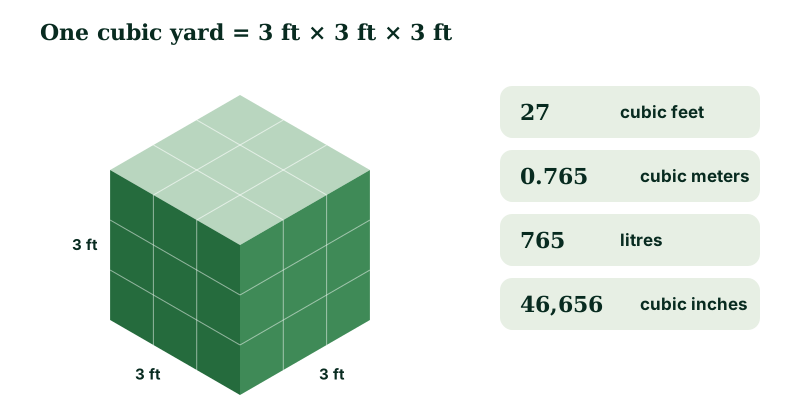
A cubic yard is a cube 3 feet long, 3 feet wide and 3 feet high, which is 27 cubic feet. To find cubic yards, work out the volume in cubic feet and divide by 27.
Depth in inches → divide by 12 to get feet
Worked examples
- Rectangle: 12 ft × 10 ft at 4 in deep → 12 × 10 × 0.333 = 40 cu ft → 1.48 cubic yards.
- Circle: 8 ft diameter at 3 in deep → 3.1416 × 4² × 0.25 = 12.57 cu ft → 0.47 cubic yards.
- Triangle: base 10 ft, height 6 ft, 4 in deep → ½ × 10 × 6 × 0.333 = 10 cu ft → 0.37 cubic yards.
Cubic yard conversion chart
| Unit | Equals |
|---|---|
| 1 cubic yard | 27 cubic feet |
| 1 cubic yard | 46,656 cubic inches |
| 1 cubic yard | 0.7646 cubic meters |
| 1 cubic meter | 1.308 cubic yards |
| 1 cubic foot | 0.037 cubic yards |
How much does one cubic yard cover?
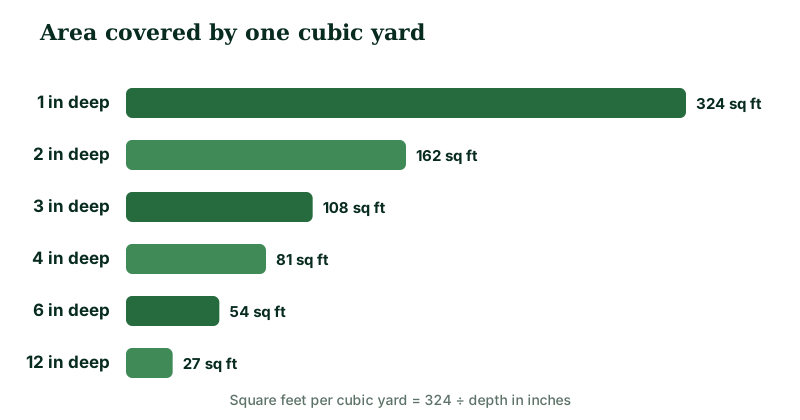
| Depth | Area covered by 1 cubic yard |
|---|---|
| 1 inch | 324 sq ft |
| 2 inches | 162 sq ft |
| 3 inches | 108 sq ft |
| 4 inches | 81 sq ft |
| 6 inches | 54 sq ft |
| 12 inches | 27 sq ft |
Converting cubic yards to tons
Suppliers of stone, sand and soil often sell by the ton. Multiply cubic yards by the material's weight per yard. Typical values are in our material weight chart, but always confirm with your supplier because moisture and material type change the weight.
Measuring irregular areas
Break a curved or L-shaped area into simple shapes, calculate each one, and add them together. If the depth changes, measure it in several spots and use the average.
Keep going
Related calculators
Frequently Asked Questions
How do I convert square feet to cubic yards?
Multiply square feet by the depth in feet (inches ÷ 12), then divide by 27. Example: 300 sq ft at 4 inches = 300 × 0.333 ÷ 27 ≈ 3.7 cubic yards.
How many cubic yards are in a 10x10 slab 4 inches thick?
10 × 10 × 0.333 = 33.3 cubic feet, which is about 1.23 cubic yards.
Is a yard the same as a cubic yard?
When people order gravel, soil or mulch, 'a yard' almost always means one cubic yard (27 cubic feet).
How many cubic feet are in a cubic yard?
27 cubic feet.
How do I convert cubic yards to tons?
Multiply cubic yards by the material's weight in tons per cubic yard. For example, 3 yards of gravel at 1.4 t/yd³ is 4.2 tons.
How much area does one cubic yard cover?
How many 80-lb bags of concrete make a cubic yard?
An 80 lb bag of concrete mix yields about 0.60 cubic feet, so a cubic yard (27 cu ft) takes 45 bags. A 60 lb bag yields about 0.45 cu ft (60 bags per yard) and a 40 lb bag about 0.30 cu ft (90 bags). The calculator above counts bags for your volume; add 5–10% for spillage and uneven ground. See bags vs bulk for when ready-mix wins.
When should I order ready-mix instead of bags?
Bags make sense up to about ½ yard (roughly 23 bags of 80 lb). Between ½ and 1 yard it depends on access, help and price. Above 1 yard, a ready-mix truck is usually cheaper and gives a more consistent pour. Many plants charge a short-load fee for small orders, so ask about the minimum before you book. The bag vs bulk guide walks through the comparison.
How do suppliers sell material – do I round up to quarter-yard increments?
Most landscape yards load bulk material by the scoop and sell it in ¼ or ½ yard steps, often with a minimum order. Ready-mix concrete is also ordered in ¼ or ½ yard increments. The "Round order up to" setting above rounds your result to your supplier's step so you do not come up short. Quarries that sell stone by weight round to the ton instead – use the gravel calculator for tons.
Will a cubic yard fit in my pickup truck?
By volume, often yes – a full-size short bed holds about 1.5–2 cubic yards level. By weight, often no. A yard of mulch weighs about 400–800 lb, but a yard of topsoil is around 2,000–2,700 lb and a yard of gravel about 2,800 lb – more than the payload of many half-ton pickups. Check the payload sticker on the driver's door and the material weight chart before you load up.