 Yard
YardHow many bags make a cubic yard?
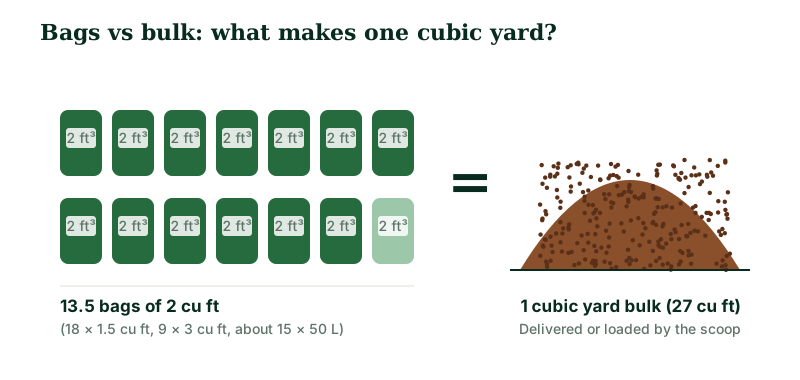
Everything starts with one number: a cubic yard is 27 cubic feet. Divide 27 by the bag size in cubic feet and you have the bags per yard.
| Material | Common bag | Bags per cubic yard |
|---|---|---|
| Mulch | 2 cu ft | 13.5 |
| Mulch | 3 cu ft | 9 |
| Mulch | 1.5 cu ft | 18 |
| Mulch / soil | 50 L (1.77 cu ft) | about 15.3 |
| Topsoil | 0.75 cu ft | 36 |
| Garden soil | 1 cu ft | 27 |
| Gravel / pea gravel | 0.5 cu ft (about 50 lb) | about 54 |
| Play or paver sand | 0.5 cu ft (about 50 lb) | about 54 |
| Concrete mix | 80 lb (0.60 cu ft yield) | 45 |
| Concrete mix | 60 lb (0.45 cu ft yield) | 60 |
Bag sizes vary by brand, so always check the label. The mulch, topsoil and cubic yard calculators count bags for you.
The break-even formula
To compare fairly, put both options on the same basis – the cost of the whole job, delivered:
Bagged cost = bags needed × price per bag
Bulk cost = cubic yards × price per yard + delivery fee
Bulk becomes cheaper once the savings per yard cover the delivery fee:
Break-even yards = delivery fee ÷ (bags per yard × bag price − bulk price per yard)
Worked example (example prices – use your own)
Suppose 2 cu ft bags of mulch cost $4 each, bulk mulch is $40 per yard and delivery is $60. A yard of bags costs 13.5 × $4 = $54, so bulk saves $14 per yard. Break-even is $60 ÷ $14 ≈ 4.3 yards.
| Yards needed | Bags (13.5/yd × $4) | Bulk ($40/yd + $60) | Cheaper |
|---|---|---|---|
| 1 | $56 (14 bags) | $100 | Bags |
| 2 | $108 (27 bags) | $140 | Bags |
| 4 | $216 (54 bags) | $220 | About even |
| 6 | $324 (81 bags) | $300 | Bulk |
| 10 | $540 (135 bags) | $460 | Bulk |
If you can collect bulk yourself – no delivery fee – bulk wins from the first yard in this example. Bag sales, multi-bag discounts and free delivery promotions move the break-even point, so run the numbers with real quotes. Every calculator has optional price fields for exactly this.
Example: mulching a 600 sq ft yard
Say you have 600 sq ft of beds to cover 3 inches deep. That is 600 × 3 ÷ 12 = 150 cubic feet, or about 5.6 cubic yards. Add 5% for settling and you need roughly 157 cubic feet.
- Bagged: 157 ÷ 2 = 79 bags of 2 cu ft. At the example price of $4 a bag that is $316 – and four or five car trips, 79 bags to lift twice and 79 plastic bags to throw away.
- Bulk: most yards sell in ½ yard steps, so you would order 6 yards. At $40 a yard plus $60 delivery that is $300, dumped on the driveway in one visit.
On price alone the two are close, but bulk saves several hours of hauling. If the same yard needed only 1.5 cubic yards for a top-up, the bags would win easily: 21 bags for $84 against $120 delivered. That is why there is no single answer – the size of the job decides it. Run your own numbers in the mulch calculator, which shows bag and bulk cost side by side.
Costs that are not on the price tag
- Your time and back. Ten yards of mulch is 135 bags to lift into a cart, a car and a wheelbarrow, then slit open. Bulk is shoveled once, straight into the barrow.
- Trips. A car holds maybe 10–20 bags. Count the trips and the fuel.
- Plastic waste. Bags go to landfill; bulk does not.
- Driveway and lawn. A loaded dump truck is heavy. Have bulk dumped on a tarp on the driveway, not the lawn, and keep it off septic systems and thin pavement.
- Storage. Bags can sit neatly in a garage for weeks. A bulk pile needs to be spread within days, especially if rain is coming.
- Minimum orders. Many yards have a minimum delivery or a "short load" fee for small orders. Ready-mix concrete plants often charge extra for small loads too.
Quality and consistency
Bagged products are screened, consistent and labeled, which matters for raised beds, playgrounds and concrete. Bulk quality varies more by supplier: ask to see the pile, ask whether topsoil is screened, and ask for the same batch if you need dyed mulch to match. For stone, bulk is usually the only practical option beyond a small path – see the gravel calculator for tons and truckloads.
Picking up bulk yourself
Many landscape yards will load bulk material into a pickup or trailer by the scoop. Watch the weight: a cubic yard of mulch weighs roughly 400–800 lb, but a yard of topsoil is around 2,000–2,700 lb and a yard of gravel about 2,800 lb – more than many half-ton pickups can legally carry. Check the payload on the door sticker and the material weight chart before you go.
Quick rules of thumb
| Material | Bags usually make sense | Bulk usually makes sense |
|---|---|---|
| Mulch | Under about 2–3 yards, top-ups, hard-to-reach beds | Whole-yard projects, many trees, new beds |
| Topsoil / garden soil | A few containers or small raised beds | Lawns, leveling, several raised beds |
| Gravel | Small paths, pots, drainage around a downspout | Driveways, patios, French drains |
| Sand | Paver joints, sandboxes | Paver bedding for a large patio |
| Concrete | Up to about ½ yard – posts, small pads | Above about 1 yard – slabs, driveways |
How to order bulk without waste
- Measure carefully and run the numbers in the right calculator, including the extra for settling or compaction.
- Round up to your supplier's step – most sell in ¼ or ½ yard increments. The cubic yard calculator rounds for you.
- Ask for the delivery fee, minimum order and truck size before you commit.
- Split a load with a neighbor if you only need half the minimum.
- Have a tarp, wheelbarrows and help ready on delivery day.
Frequently Asked Questions
Is it cheaper to buy mulch in bags or bulk?
For small jobs, bags are often cheaper because there is no delivery fee. For more than about 2–4 yards, bulk usually wins. Use the break-even formula above with your own prices, or the price fields in the mulch calculator.
How many bags of soil make a yard?
36 bags of 0.75 cu ft, 27 bags of 1 cu ft, 18 bags of 1.5 cu ft or 13.5 bags of 2 cu ft. See the topsoil calculator.
When should I order ready-mix concrete instead of bags?
Bags make sense up to about ½ yard (roughly 23 bags of 80 lb). Above about 1 yard, ready-mix is usually cheaper and gives a better pour. The cubic yard calculator counts concrete bags.
Can I fit a yard of gravel in my pickup?
It fits by volume but often not by weight: a yard of gravel weighs about 2,800 lb. Check your payload and the material weight chart.