 Yard
YardBefore you start: permits and full vs partial removal
Most towns and counties require a permit to fill in a pool, and many ask for an inspection of the compaction before you cover it with topsoil. Call your building department before you book trucks – it costs nothing and avoids having to dig the work back up.
There are two common approaches:
- Partial removal (abandonment). The top 18–36 inches of the pool walls are broken down, holes are punched through the floor so water can drain, the rubble is left in the bottom and the pool is backfilled. It is cheaper, but the area is often treated as unsuitable for building on later, and you may need to disclose it when you sell.
- Full removal. All concrete, steel and liner are hauled away and the hole is backfilled and compacted to an engineer's spec. It costs more but leaves buildable ground.
The fill calculation is almost the same for both. With partial removal, the broken concrete takes up some volume at the bottom; with full removal, the hole is usually a little bigger than the water volume because the walls and floor come out too.
Step 1: Work out the pool's volume
For a rectangular pool, multiply length × width × average depth in feet to get cubic feet, then divide by 27 for cubic yards. If the floor slopes evenly from a shallow end to a deep end, the average depth is simply (shallow + deep) ÷ 2. A pool that runs from 3.5 ft to 6.5 ft averages 5 ft.
Diving pools with a hopper (a deep pit under the board) hold more than a straight slope suggests. Measure the depth at five or six points, average them, and use that figure. For oval or kidney-shaped pools, multiply length × width × average depth × 0.785 – the same factor used for an ellipse – and round up.
The cubic yard calculator handles rectangles, circles and triangles, so you can split an odd-shaped pool into pieces and add them up.
Step 2: Add the compaction factor
Dirt arrives loose and fluffy. Once it is spread and compacted in the hole, it takes up much less space – so ordering exactly the pool's volume leaves you short. The usual rule is to order 1.25 to 1.30 loose cubic yards for every compacted cubic yard you need. Use the higher number for clay or when the fill will be compacted hard for a future patio or shed. The fill dirt calculator applies this factor automatically and explains loose, delivered and compacted volume in detail.
How much fill for common pool sizes
The table assumes a rectangular pool averaging 5 ft deep, the top 6 inches finished with topsoil, and tandem dump trucks carrying about 10 cubic yards each.
| Pool size | Pool volume | Fill to order (×1.25–1.30) | Topsoil (6 in) | Tandem loads of fill |
|---|---|---|---|---|
| 12 × 24 ft | 53 yd³ | 60–62 yd³ | 5.3 yd³ | 6–7 |
| 14 × 28 ft | 73 yd³ | 82–85 yd³ | 7.3 yd³ | 9 |
| 16 × 32 ft | 95 yd³ | 107–111 yd³ | 9.5 yd³ | 11–12 |
| 18 × 36 ft | 120 yd³ | 135–140 yd³ | 12 yd³ | 14–15 |
| 20 × 40 ft | 148 yd³ | 167–173 yd³ | 14.8 yd³ | 17–18 |
Above-ground pools are a different job: the pool is removed, and you usually only need to level the ground and add a few inches of topsoil. Use the topsoil calculator for that.
Step 3: Plan the layers
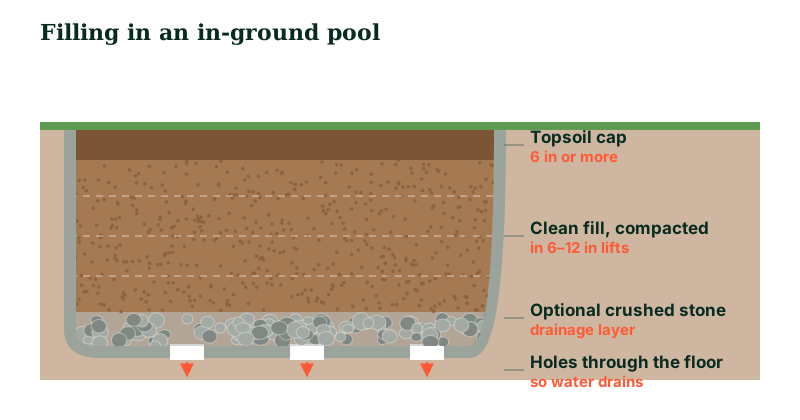
A filled pool is built in layers, from the bottom up:
- Drainage at the bottom. Break several large holes through the floor (or remove it) so rain and groundwater can drain away instead of collecting in a buried concrete bowl. Some contractors add a layer of crushed stone at the bottom to help drainage; size it with the gravel calculator and subtract it from the fill volume.
- Fill dirt in lifts. Spread clean fill in layers of about 6–12 inches and compact each one before adding the next. Dumping the whole load and compacting only the top leaves soft pockets that settle for years.
- Topsoil cap. Finish with at least 6 inches of screened topsoil so grass and plants can root. Fill dirt is subsoil and grows almost nothing on its own.
What kind of fill to use
Ask for clean fill: soil without trash, roots, stumps, large rocks or chunks of concrete. Organic material rots and leaves voids, and big rocks bridge over gaps that collapse later. Sandy or loamy fill compacts well and drains; heavy clay compacts but holds water and can swell and shrink with the seasons. If you are offered free fill, ask where it came from – soil from a gas station or industrial site can be contaminated. See the fill dirt calculator FAQs for where to find fill.
Step 4: Trucks, access and scheduling
Divide the loose yards by what each truck carries. A tandem dump truck typically hauls 10–14 cubic yards of dirt, but heavy, wet soil hits the weight limit before the bed is full, so ask your hauler what they actually deliver. A tri-axle carries more but needs more room to turn.
- Check that a loaded truck – often 25–35 tons – can reach the pool without crossing a septic system, a thin driveway or soft lawn. If it cannot, the dirt is dumped at the curb and moved with a skid steer.
- Schedule loads so the compaction crew keeps up. Ten loads in a morning is no help if each lift needs time to compact.
- Keep the topsoil separate and order it last, once the fill has been compacted and inspected.
The fill-in process, start to finish
- Get the permit and confirm whether the inspector needs to see the compaction.
- Drain the pool. Many areas restrict draining chlorinated water into storm drains, so check local rules first.
- Remove the deck, coping and equipment, and disconnect and cap the plumbing and electrical.
- Break the floor and the top of the walls (partial removal), or demolish and haul away the whole shell (full removal).
- Add any drainage stone, then the fill in compacted lifts.
- Grade the surface slightly above the surrounding ground to allow for final settling, and slope it away from the house.
- Spread the topsoil, then seed or sod.
Common mistakes
- Ordering the pool volume only. Without the 25–30% compaction allowance you will run short by two or three truckloads.
- Skipping drainage holes. A solid floor holds water and the fill above it turns to mud.
- Filling all at once. Deep, uncompacted fill keeps sinking for years and leaves a hollow in the lawn.
- Using fill as the top layer. Grass struggles in subsoil – budget for topsoil from the start.
Once the pool is filled, use the topsoil calculator to order the cap and the raised bed guide if you plan a garden on the spot.
Frequently Asked Questions
How many yards of dirt does it take to fill a pool?
Multiply length × width × average depth, divide by 27, and add 25–30% for compaction. A 16 × 32 ft pool averaging 5 ft deep needs about 107–111 loose yards of fill plus about 9.5 yards of topsoil for a 6 inch cap. Use the fill dirt calculator for your size.
Can I build on a filled-in pool?
Only if the pool was fully removed and the fill was compacted and tested to an engineer's spec. A partially removed pool with rubble left in the bottom is usually considered unsuitable for buildings. Check with your local building department before you plan a shed, patio or addition.
Do I need gravel at the bottom of a filled pool?
It is not always required, but a layer of crushed stone over a broken floor helps water drain away. Many contractors use it with partial removal. Size it with the gravel calculator and subtract it from the fill volume.
How long does a filled pool take to settle?
Fill compacted in thin lifts settles little. Fill dumped in one go can keep settling for a year or more. Mound the finished surface slightly and top up low spots with topsoil after the first season.